PSSS2: Designs and implements activities that use children's own stories as a way to introduce the chronological thinking essential to historical thinking
Evidence 1: Photographs of Children at the Post Office
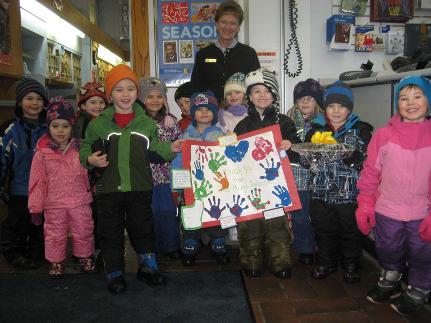
Description: This photograph was taken when our class walked to the post office to deliver a tray of brownies and a thank you note for the service they provide our town.
Analysis: Our trip to the Post Office was exciting for many reasons. The woman that we delivered brownies to happened to be the grandmother of one of our preschoolers. He really enjoyed seeing grandma in a non-traditional setting. We were also able to learn about the relationship between this post-mistress and her environment as she showed us around the post office. We were able to see how mail was sorted and placed in mailboxes, how packages were weighed and where they went after they were post marked. Children learned about the many important jobs that happen when mail is delivered to the post office.
Evidence 2: Photographs of Children Celebrating Our Community
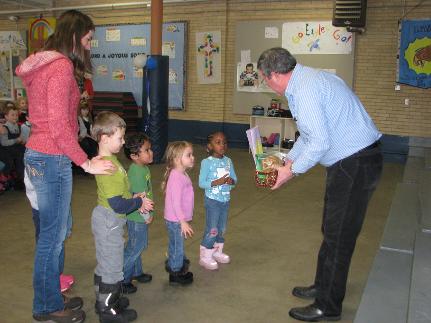
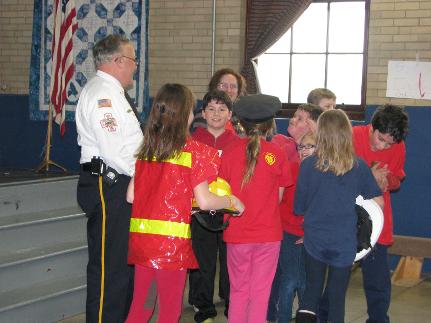
Description: During Catholic Schools Week, we invite members of our community to join us at school so that we can celebrate all that they do for us. These photographs were taken at one of these celebrations.
Analysis: During this celebration we were able to meet a fire fighter, a police officer, a doctor and our priest. Children were also encouraged to dress up as a member of a community organization as well. As children pretended to be fire fighters, police officers and doctors throughout their play time, my co-teacher and I were able to observe each child's current level of understanding for each profession. When children met these individuals and learned more about their jobs and then returned to play during the course of the next few days, we noted each child's change in understanding. Fire fighters don't just put out fires. They also need to check and maintain their tools. Police officers don't just arrest bad guys. They also have to fill out paper work. Each child's understanding increased.
Evidence 3: Photographs of Fire Fighters Visiting
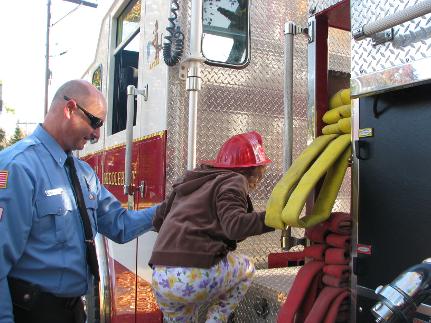
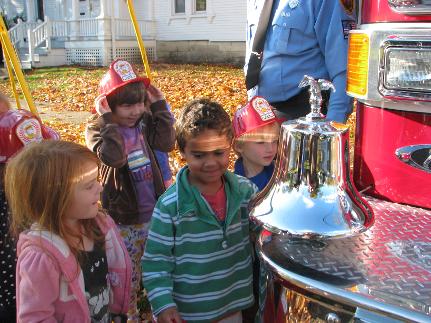
Description: These photographs were taken when the local fire department came to visit our school. Each child got to climb on the truck, ring the bell and ask questions.
Analysis: When the fire fighters visit they teach us how to be safe if there is ever a fire at school or in our homes. They show children unsafe tools such as lighters and matches, and help children learn to tell an adult about those things. They also teach children what to do if their clothes catch on fire: stop, drop and roll. After teaching children these important lessons, children are able to practice. The fire fighters also show the preschoolers what they look like in full turn out gear, and show them all of the tools that they use to be safe when in a burning building. For weeks after the fire fighters come, children incorporate what they learn into their play. Their stories become richer with each reenactment and with each piece of remembered knowledge.
