PSMA4: Designs and incorporates mathematical tasks/activities that capitalize upon children's intuitive insights and language and that enable children to investigate, explore, and discover structures and relationships; create and use mathematical models; apply informal strategies to solve mathematical problems; formulate and solve problems individually and collaboratively; and justify and communicate their conclusions orally and in writing
Evidence 1: Photograph of Apple Graph
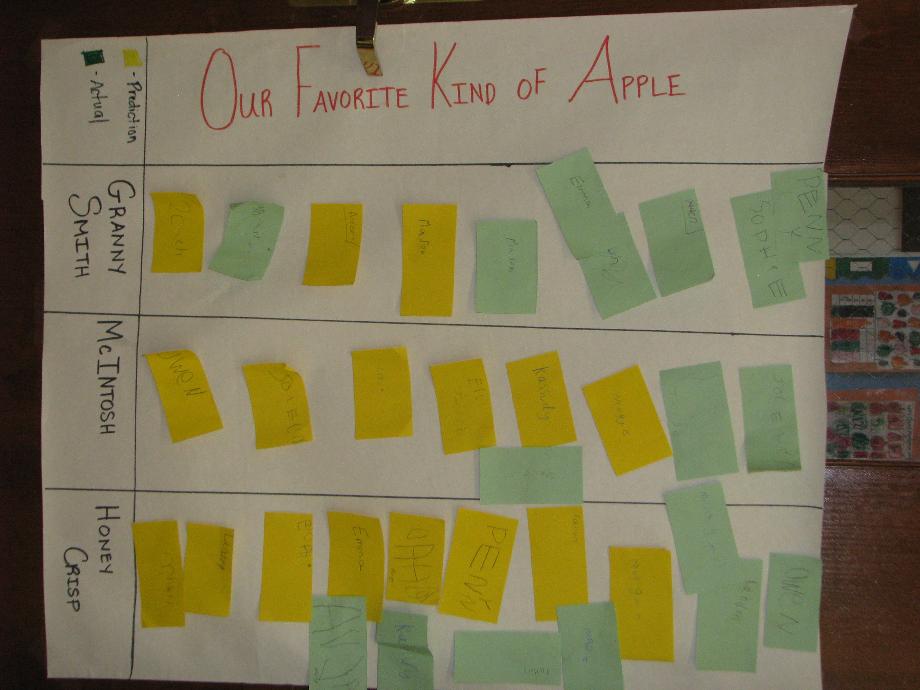
Description: Every year children are asked to predict which type of apple they will like best, McIntosh, Honey Crisp or Granny Smith. Children then taste test all three types of apple and record their favorite on a graph.
Analysis: While picking apples at the orchard, children noticed the various ribbons on trees indicating a variety of apples. Wanting to know the difference between these apples we chose three to bring back to our classroom. Children explored the apples using our classroom scale and then used their five senses to note differences in sight, touch, smell and taste. Children used a chart to record predictions and results as they taste tested each apple. As they ate, children discussed their observations with each other, and we were able to determine that the same amount of people liked the Granny Smith and Honey Crisp apples.
Evidence 2: Photographs of Pom Pom Game
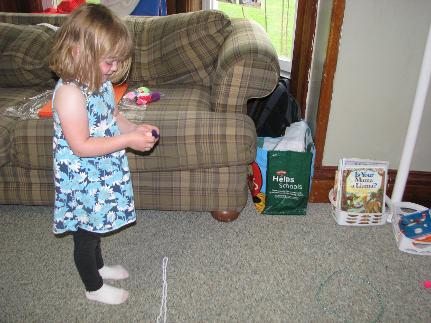
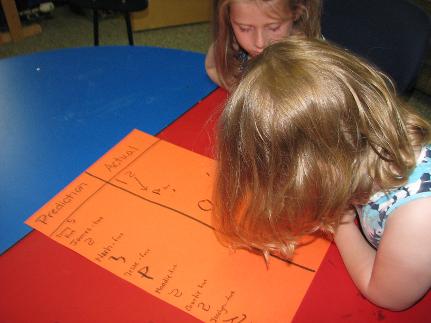
Description: These are photographs of the Pom Pom Toss game. Children are given five pom poms are asked to predict how many will land in a specified circle. After throwing the pom poms, children record the actual number on the graph.
Analysis: During this lesson, children are able to explore the relationship between prediction and results. They practice writing numerals as they record their predictions and results and experience various models of recording information. They also work together to determine the best way to throw a pom-pom so that it will land in the circle.
Evidence 3: "Hannah's Collections" Lesson Plan
Description: I planned this lesson based on sorting after reading the book , "Hannah's Collections".
Analysis: This lesson allows children the opportunity to gather materials and then sort those materials into their own collections. When children have finished sorting their items, they use their words to explain to the other children what their thought process was while sorting.
